

Last summer, I found myself doubled over with heartburn after gulping down two huge mango slices on an empty stomach. My stomach was churning, and I couldn't understand why. I'd always thought mangoes were one of those gentle, healthy fruits that everyone could enjoy without worry. That uncomfortable episode sent me straight to my granny's kitchen, where she pulled out her worn recipe book filled with decades of health notes she'd collected while managing my grandfather's diabetes and digestive issues.
She flipped to a page about fruits and acidity, pointing to her handwritten notes about mangoes. Turns out, I wasn't the only one in our family who'd had this problem. My grandfather experienced similar issues years ago, and granny had done her homework. She explained that while mangoes aren't super acidic like lemons or oranges, they do contain natural acids that can bother some people, especially when eaten the wrong way.
That conversation changed how I eat mangoes, and I want to share what I learned with you. If you've ever wondered whether mangoes are acidic, whether they might trigger your heartburn, or how to enjoy them without digestive drama, keep reading. I'm breaking down the science, sharing practical tips, and giving you the real-world guidance that helped me fall back in love with this delicious fruit.
Quick Answer: So, Are Mangoes Acidic?
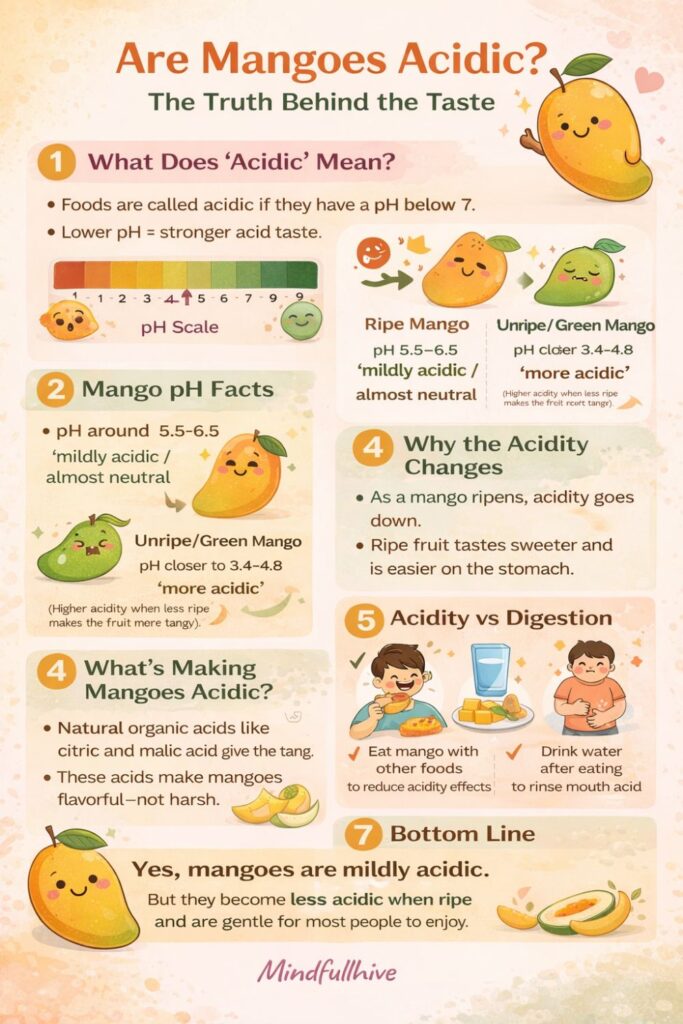
Yes, mangoes are mildly acidic. Typical mango pulp has a pH level between 5.5 and 6.5, depending on the variety and how ripe the fruit is. This acidity comes mainly from citric acid and malic acid. Ripe mangoes are sweeter and generally less likely to trigger heartburn compared to unripe ones, but people with sensitive stomachs should start with small portions and pay attention to how their body reacts.
The good news? Mangoes are significantly less acidic than citrus fruits like oranges or grapefruits, making them a gentler option for most people.
What Does "Acidic" Actually Mean? Understanding pH Basics
Before we dive deeper into mango acidity, let's get clear on what we mean by acidic. The pH scale runs from 0 to 14, where 7 is neutral (like pure water). Anything below 7 is acidic, and anything above 7 is alkaline or basic.
Highly acidic foods sit around pH 2-4 (think lemon juice at pH 2, vinegar at pH 3). Mildly acidic foods fall in the pH 4-6 range, while neutral to slightly alkaline foods are pH 6-8.
When granny explained this to me using her notes from various health articles, she drew a simple line showing where different foods fall. Battery acid sits at the extreme low end (pH 1), stomach acid at pH 1.5-2, coffee around pH 5, and pure water at pH 7. Mangoes land comfortably in the middle-ground zone, making them far easier on your digestive system than truly acidic foods.
Your stomach naturally produces hydrochloric acid with a pH around 1.5-2 to digest food. So when you eat something with a pH of 5.5-6.5 like mango, it's actually much less acidic than your stomach environment. However, the combination of organic acids in mangoes plus individual digestive sensitivity can still cause issues for some people.
Why pH Matters for Digestion
People with acid reflux, GERD, or sensitive stomachs often need to watch acidic foods because these can relax the lower esophageal sphincter (the valve between your stomach and esophagus) or irritate already-inflamed tissue. Even mildly acidic foods can trigger symptoms in sensitive individuals, which is exactly what happened to me that day.
Understanding mango pH level helps you make informed choices about portion sizes, timing, and preparation methods.
The Science Behind Mango Acidity: What Acids Are Actually In Mangoes
When I asked granny why mangoes tasted both sweet and tangy, she explained that mangoes contain several organic acids that give them their characteristic flavor profile. According to research published in chemical composition studies, the main acids in mango fruit are:
Citric acid is the dominant acid in most mango varieties. This is the same acid found in citrus fruits, though mangoes contain significantly less of it. Citric acid gives that bright, tangy note you taste when you bite into a slice.
Malic acid is the second major acid present. This acid also appears in apples and contributes to the fruit's overall tartness and complexity.
Smaller amounts of other organic acids like tartaric acid and oxalic acid are present too, but in much lower concentrations.
The total acid content in mango pulp typically ranges from 0.1% to 0.5% depending on variety and ripeness. Compare this to oranges, which contain 0.6% to 1.0% citric acid, and you can see why mangoes taste milder.
These acids serve important purposes beyond flavor. They act as natural preservatives, help maintain vitamin C levels in the fruit, and contribute to mango nutrition by supporting various metabolic processes in your body.
My granny's notes referenced several health publications that emphasized how citric acid and malic acid aren't necessarily bad for you. In fact, citric acid can help with iron absorption and may even have alkalizing effects once metabolized, despite being acidic in the fruit itself.
How Ripeness Changes Mango Acidity (This Is Where Things Get Interesting)
Here's what completely changed my mango-eating game: ripe vs unripe mango acidity varies dramatically. That painful heartburn incident? I'd eaten slightly unripe mango pieces without realizing it.
As mangoes ripen, something magical happens. The fruit's enzymes break down organic acids and convert starches into sugars. This means:
Unripe mangoes are notably more acidic, with pH levels closer to 5.0-5.5. They taste tart, almost sour, and contain higher concentrations of citric and malic acids. The flesh is firm and sometimes has an astringent quality.
Ripe mangoes have pH levels closer to 6.0-6.5. The sugar content increases significantly while acid levels drop. They taste sweeter, softer, and much gentler on your stomach.
Granny had written a simple rule in her book: "Wait for golden yellow. Green means wait." She was absolutely right. The ripeness and sugar conversion process is your best friend if you're worried about acidity.
I created a simple comparison based on various nutritional studies:
Unripe Mango:
- pH: approximately 5.0-5.5
- Taste: tart, sour, astringent
- Acid content: higher
- Best for: cooking, pickles, chutneys
Semi-ripe Mango:
- pH: approximately 5.5-6.0
- Taste: sweet-tart balance
- Acid content: moderate
- Best for: salads, salsas
Fully Ripe Mango:
- pH: approximately 6.0-6.5
- Taste: sweet, mild tartness
- Acid content: lower
- Best for: fresh eating, smoothies, desserts
The variety of mango also matters. Alphonso mangoes tend to be sweeter and less acidic when ripe compared to raw mango varieties traditionally used for pickles. Ataulfo (honey) mangoes are known for being particularly sweet and mild.
How Do Mangoes Compare to Other Fruits? A pH Comparison
When I started paying attention to acidity of mango fruit compared to other fruits I regularly ate, I realized mangoes were actually one of the gentler options. Here's what the research and granny's notes showed me:
Highly Acidic Fruits (pH 2.0-4.0):
- Lemon: pH 2.0-2.5
- Lime: pH 2.0-2.4
- Cranberry: pH 2.3-2.5
- Grapefruit: pH 3.0-3.5
- Pineapple: pH 3.3-5.2
- Orange: pH 3.5-4.5
Moderately Acidic Fruits (pH 4.0-5.5):
- Apple: pH 3.3-4.0
- Grape: pH 3.5-4.5
- Peach: pH 3.4-4.1
- Cherry: pH 3.6-4.5
- Strawberry: pH 3.0-3.9
Mildly Acidic to Near-Neutral Fruits (pH 5.5-6.5):
- Mango: pH 5.5-6.5
- Papaya: pH 5.2-6.0
- Banana: pH 4.5-5.2 (gets less acidic as it ripens)
- Melon: pH 6.0-6.7
- Watermelon: pH 5.2-5.8
As you can see, mangoes are less acidic than most citrus fruits and sit comfortably in the milder range. This makes them a much safer choice if you're looking for acid reflux friendly fruits.
My granny always kept bananas and papayas around because she knew they were gentle. Now I understand that fully ripe mangoes belong in that same category. When you compare mango to oranges, the difference is significant. Oranges can have a pH as low as 3.5, making them roughly 10-100 times more acidic than a ripe mango (remember, pH is a logarithmic scale).
Mangoes and Acid Reflux: Who Should Be Careful
Let me be honest about my experience. That heartburn incident taught me that even mildly acidic foods can cause problems if you have certain conditions or eat them incorrectly. So let's talk about are mangoes acidic for acid reflux sufferers.
Can Mangoes Trigger Heartburn?
Do mangoes cause heartburn? For most people, no. Mangoes are generally well-tolerated and less likely to trigger acid reflux symptoms compared to citrus fruits, tomatoes, or spicy foods. However, individual tolerance and sensitivity varies wildly.
Some people with GERD (gastroesophageal reflux disease) find that any acidic food, even mild ones, can trigger symptoms. Others do fine with mangoes as long as they follow certain guidelines.
Factors that increase the likelihood of mango-related heartburn:
- Eating unripe or semi-ripe mangoes: Higher acid content means greater chance of irritation.
- Large portions: Eating too much at once overwhelms your digestive system. My mistake was eating two huge slices on an empty stomach.
- Empty stomach consumption: Acidic foods hit harder when there's nothing else to buffer them.
- Existing digestive inflammation: If your esophagus or stomach lining is already irritated, even mild acids can hurt.
- Individual sensitivity: Some people just react more strongly to certain foods, and that's okay.
Who Should Exercise Caution
If you have acid reflux, heartburn, or GERD, here's what I learned (both from experience and granny's research):
Start with small portions. My granny's rule was "test with a few bites first." Quarter-cup servings are a smart starting point.
Choose fully ripe mangoes only. Check that the fruit yields slightly to pressure and has that sweet, floral aroma.
Eat mangoes with or after meals, not on an empty stomach. Having other foods in your stomach helps buffer the acidity.
Avoid very cold mangoes straight from the fridge if you're sensitive. Cold foods can slow digestion and increase reflux risk for some people.
Track your reactions in a food journal. What triggers symptoms for one person might be perfectly fine for another.
If mango consistently triggers your symptoms despite following these guidelines, it might be one of your personal trigger foods. That's okay. Listen to your body above all else.
How to Enjoy Mangoes If You Have a Sensitive Stomach
After my uncomfortable experience, I didn't want to give up mangoes forever. They're too delicious and nutritious. So I worked with granny to figure out ways to eat mangoes that wouldn't upset my stomach. Here are the practical tips that actually work:
Pairing and Preparation Strategies
- Combine with plain low-fat yogurt: This was granny's go-to recommendation. Yogurt provides protein and fat that help slow digestion and buffer acidity. Plus, the probiotics in yogurt support digestive health. Our family often enjoys mango lassi (mango blended with yogurt) as a moderate treat.
- Blend into smoothies with neutral ingredients: Mixing mango with banana, milk or plant-based milk, and a bit of honey creates a balanced drink that's easier on your stomach than eating raw mango alone. The added volume and dilution help tremendously.
- Cook or roast the mango: Heat can mellow acids and bring out natural sweetness. Grilled mango is amazing, and cooked mango in curries or chutneys paired with rice dishes provides a gentler eating experience.
- Eat smaller, more frequent portions: Instead of two huge slices, have a few small cubes with breakfast and a few more as an afternoon snack. This approach prevents overwhelming your digestive system.
Timing Matters
- Never on an empty stomach: I learned this the hard way. Always eat mango as part of a balanced meal or after you've had other food.
- Avoid right before bed: Lying down shortly after eating acidic foods increases reflux risk. Give yourself at least two to three hours between eating mango and lying down.
- Mid-morning or afternoon is ideal: These times align with when your digestive system is most active and robust.
Recipe Ideas for Sensitive Stomachs
Granny shared several recipes and smoothies she'd developed over the years for my grandfather:
- Gentle Mango Smoothie: Blend one cup ripe mango chunks, one ripe banana, one cup almond milk, one tablespoon ground flaxseed, and a pinch of cinnamon. The banana and milk buffer acidity while adding fiber and nutrients.
- Mango Rice Pudding: Cook rice in milk until creamy, stir in small diced ripe mango, and sweeten with a bit of honey. The starch and dairy create a soothing combination.
- Mango Yogurt Parfait: Layer plain yogurt, small amounts of mango, and granola. The protein and complex carbs balance the fruit's natural acids.
- Mango Chutney (cooked): Cooking mango with spices and a touch of sweetener reduces acidity while creating a flavorful condiment for meals.
Being sensitive to certain foods doesn't mean you have to eliminate them completely. It just means being smart about how and when you enjoy them.
The Nutritional Benefits That Make Mangoes Worth It
Despite the acidity concerns, mangoes pack serious nutritional value that shouldn't be overlooked. This is where granny's notes really shined because she'd collected information on mango nutrition specifically to help my grandfather get essential vitamins while managing his diabetes.
Key Nutrients in Mangoes
- Vitamin A: One cup of mango provides about 25% of your daily vitamin A needs. This vitamin supports eye health, immune function, and skin health. Granny emphasized this because my grandfather had vision concerns related to diabetes.
- Vitamin C: Mangoes deliver roughly 75% of your daily vitamin C requirement per cup. This powerful antioxidant supports immune health, collagen production, and iron absorption. Interestingly, vitamin C is an acid (ascorbic acid), but it's generally well-tolerated even by people with reflux.
- Fiber: With about 3 grams of fiber per cup, mangoes support digestive health and help regulate blood sugar levels. The fiber also creates a feeling of fullness and can actually help protect your digestive tract.
- Folate: Important for cell growth and DNA synthesis, particularly crucial for pregnant women.
- Potassium: Supports heart health and blood pressure regulation.
- Antioxidants: Mangoes contain mangiferin, beta-carotene, and other compounds that fight oxidative stress and inflammation.
Why Nutrition Matters in the Acidity Conversation
The nutrition benefits that offset acidity are real. When granny explained this to me, she used the analogy of cost versus benefit. Yes, mangoes have some acidity, but they also deliver tremendous nutritional value that supports overall health.
The fiber content is particularly helpful for people worried about digestive issues. Fiber helps regulate bowel movements, feeds beneficial gut bacteria, and can actually reduce reflux symptoms in some people by promoting proper digestion.
The antioxidants and anti-inflammatory compounds in mangoes may help heal and protect the digestive tract lining over time, potentially reducing sensitivity to acidic foods.
For my grandfather managing diabetes, the vitamin A and vitamin C were critical for preventing complications, and the fiber helped with blood sugar control. Granny found ways to include small amounts of ripe mango in his diet safely.
The key is balancing moderate intake with proper preparation and timing. You're not just eating something mildly acidic; you're nourishing your body with essential vitamins and minerals.
Frequently Asked Questions About Mango Acidity
Are mangoes acidic?
Yes, mangoes are mildly acidic with a pH level typically ranging from 5.5 to 6.5, depending on variety and ripeness. This acidity comes from citric acid and malic acid naturally present in the fruit.
Do mangoes cause heartburn?
For most people, mangoes don't cause heartburn. However, individuals with acid reflux or sensitive stomachs may experience symptoms, especially if eating unripe mangoes or large portions on an empty stomach.
Is ripe or unripe mango more acidic?
Unripe mangoes are more acidic than ripe ones. As mangoes ripen, organic acids decrease while sugar content increases, making ripe mangoes sweeter and gentler on the digestive system with a higher pH around 6.0-6.5.
How does mango compare to oranges in terms of acidity?
Mangoes are significantly less acidic than oranges. While mango pH sits around 5.5-6.5, oranges have a pH of 3.5-4.5, making them roughly 10-100 times more acidic than mangoes.
Can I eat mango if I have GERD?
If mango doesn't trigger your GERD symptoms, moderate portions are generally safe. Choose fully ripe fruit, eat it with meals rather than alone, start with small servings, and track your body's reaction to determine your personal tolerance.
Two Quick Tips for Enjoying Mangoes Safely
Tip 1: Try pairing mango with plain low-fat yogurt or adding it to smoothies with banana and milk. These combinations buffer the natural acidity and create a more stomach-friendly eating experience.
Tip 2: If you're testing your tolerance to mangoes, start with a small serving of about quarter-cup of fully ripe mango after a meal, not on an empty stomach. Wait a few hours and note any symptoms before increasing your portion size.
Final Thoughts: Enjoying Mangoes Wisely
Learning about are mangoes acidic transformed my relationship with this fruit. That painful heartburn episode taught me valuable lessons about listening to my body, choosing ripe fruit, and being smart about portions and timing.
Mangoes occupy a sweet spot in the fruit world. They're mildly acidic compared to citrus fruits like oranges and lemons, packed with essential nutrition including vitamin A, vitamin C, and fiber, and generally well-tolerated by most people when eaten properly.
If you have acid reflux, heartburn, or GERD, don't automatically eliminate mangoes from your diet. Instead, experiment with fully ripe varieties, small portions, strategic timing, and recipes that buffer acidity. Pay attention to your body's signals and adjust accordingly.
My granny's wisdom proved invaluable: food is meant to nourish and bring joy, not cause discomfort. With a bit of knowledge about mango pH level, ripeness, and smart eating strategies, most people can safely enjoy this delicious tropical fruit.
Now when summer comes around and mangoes fill the markets, I know exactly how to enjoy them. I wait for that perfect ripeness, eat them as part of balanced meals, and sometimes blend them into cooling smoothies with yogurt. No more heartburn, just pure mango bliss.
If you found this helpful, I'd love to hear about your experiences with mangoes and acidity. Have you had similar issues? What strategies work for you? Understanding our individual sensitivity helps us all eat more mindfully and enjoyably.