


Last month I picked up my urine test report from the lab near my house and stared at one line for almost five minutes: pus cells in urine, 15 to 20/HPF. I had gone in for a routine check because of mild burning while urinating, nothing dramatic, but that one line made my stomach drop. I did what most of us do first, I opened Google. What I found were pages full of medical jargon that made me more confused, not less.
That evening, sitting with my mom in our kitchen, I asked her if she had ever heard of pus cells in urine. She hadn't, and neither had my younger brother. So we sat together, read the report line by line, and eventually spoke to our family doctor to actually understand it. This article is everything I learned from that experience, written the way I wish someone had explained it to me that day.
What Are Pus Cells in Urine?
Pus cells in urine are simply white blood cells that show up when your urine sample is checked under a microscope. Doctors also call this pyuria, which just means an increased number of white blood cells in urine. These are the same cells your body normally sends to fight infection or inflammation anywhere else in your body, except this time they show up in your urine sample.
When the lab technician looks at your sample under a microscope, they count how many of these cells appear in one high power field, usually written as HPF on your report. That count is what shows up as "pus cells" on your urine routine report.
It sounds scary written in medical language, but a small number of pus cells in urine is actually considered normal for most healthy people. The real question, and the one that confused me the most, is where the normal range actually ends.
What Is the Normal Range of Pus Cells in Urine?
This was the first thing I wanted answered clearly, so let me keep it simple.
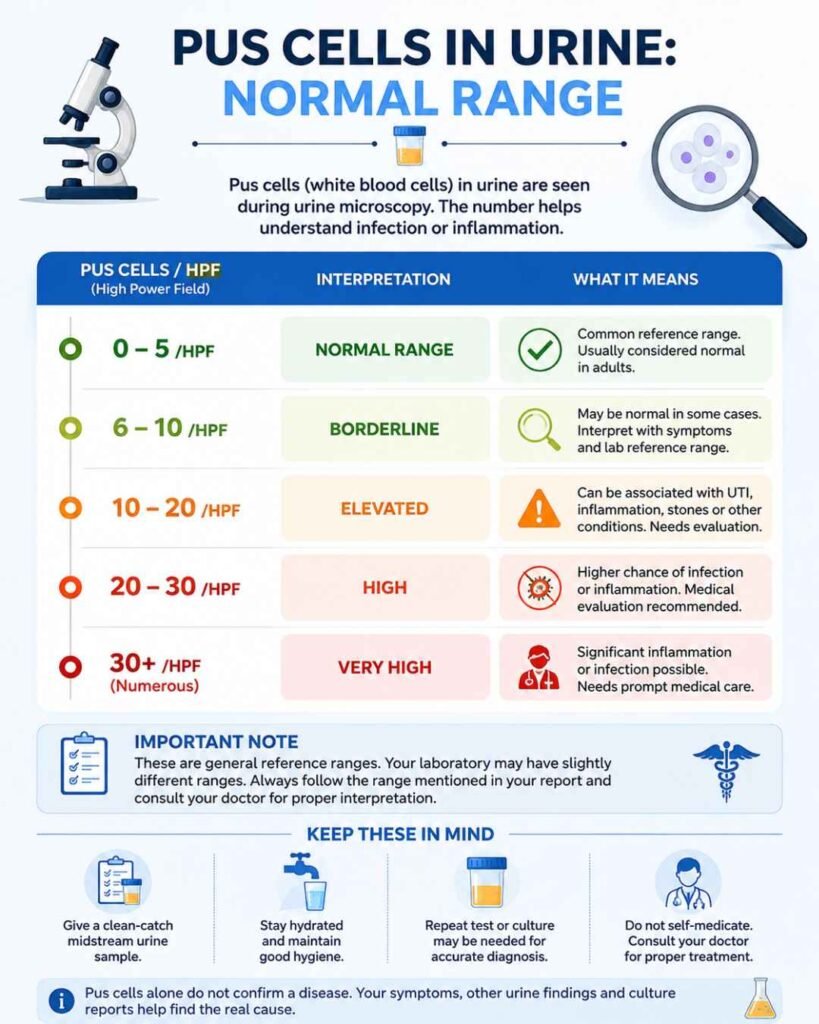
A commonly used reference range across Indian labs and hospitals is 0 to 5 pus cells per HPF. This is considered a normal range for most adults, both men and women, when the urine sample has been collected properly.
A few points worth knowing about this range:
- Different labs may print slightly different reference ranges on their reports, so always check the range mentioned on your own report first
- A clean-catch midstream urine sample gives more accurate results, meaning you let a little urine pass first and then collect the sample in the middle of urination
- If the sample is not collected properly, cells from the skin or genital area can mix in and raise the count without there being any real problem
- Women may occasionally see a slightly higher count due to normal vaginal discharge mixing with the sample, which is why doctors often ask for a repeat test if the first result feels doubtful
- Men usually show fewer contamination issues since the collection is simpler
So when my report showed 15 to 20 pus cells per HPF, it was clearly above the common range, but as my doctor explained, the number by itself does not tell the whole story. That leads to the question everyone actually searches for.
What Do 5, 10, 20 or 30 Pus Cells in Urine Mean?
This is the part I struggled with the most, because every number felt like it meant something different. Here is how it generally breaks down, in the simplest way possible.
5 pus cells per HPF usually falls within or very close to the normal reference range and often does not need any treatment on its own.
10 pus cells per HPF is slightly above the common range. Doctors usually look at your symptoms alongside this number rather than treating the number alone.
10 to 20 pus cells per HPF often points toward some degree of inflammation or a possible urinary tract infection, especially if you also have burning, urgency or discomfort.
20 to 30 pus cells per HPF is on the higher side and is more likely to need further testing such as a urine culture to identify the exact cause.
Too numerous to count, sometimes written as "plenty" or "many" on a report, usually means a fairly active infection or inflammation and needs proper medical evaluation.
My doctor made one thing very clear to me that day. A pus cell count alone does not diagnose the cause. It has to be read along with your symptoms, other findings on the same report like nitrite and leukocyte esterase, and sometimes a urine culture test. That single sentence honestly made me feel calmer than any article I had read online.
Causes of High Pus Cells in Urine
Once I understood that the number needed context, the next natural question was, what actually causes this in the first place. There are several possible reasons, and not all of them are serious.
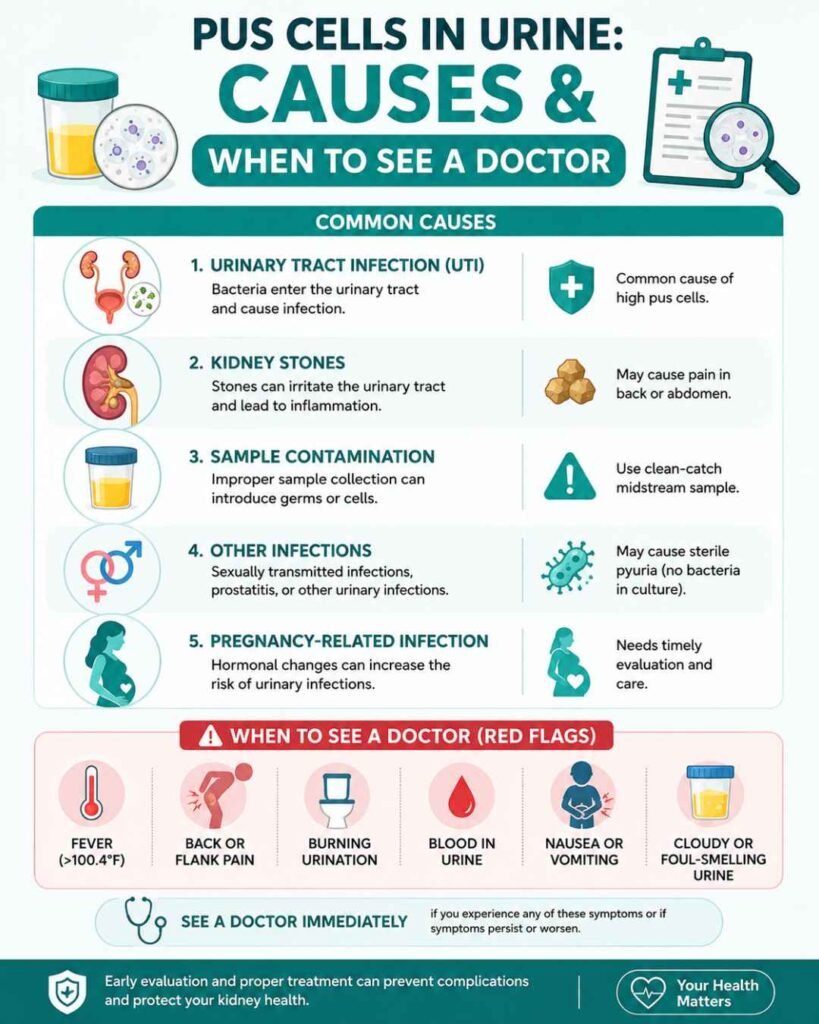
- Urinary tract infection (UTI) is the most common cause, where bacteria irritate the bladder or urinary tract and trigger white blood cells to respond
- Kidney infection can cause a similar but sometimes more intense response, often along with back pain or fever
- Kidney stones can irritate the urinary tract lining and raise pus cells even without an active infection
- Cystitis, which is inflammation of the bladder, is another common reason
- Prostatitis in men, meaning inflammation of the prostate, can also raise the count
- Sexually transmitted infections can sometimes cause what doctors call sterile pyuria, meaning pus cells are present but the standard urine culture does not show bacterial growth
- Sample contamination during collection, which is more common than people realize and often the simplest explanation
- Certain other inflammatory conditions of the urinary tract, unrelated to any infection, can also raise pus cells
In my case, once I mentioned my symptoms and we repeated the test with a proper clean-catch sample, the picture became a lot clearer.
Symptoms of High Pus Cells in Urine
Not everyone with high pus cells feels unwell. Some people find out only through a routine test, which is exactly what almost happened to me since my symptoms were mild. That said, common symptoms include:
- Burning sensation while urinating
- Needing to urinate more often than usual
- A sudden urge to urinate even with very little urine
- Mild discomfort or heaviness in the lower abdomen
- Cloudy urine or urine with an unusual smell
- Fever in more active infections
- Pain in the back or sides, which can point toward kidney involvement
If you notice several of these together, it is worth getting tested rather than waiting it out, which is exactly what pushed me to visit the lab in the first place.
How Pus Cells in Urine Are Diagnosed
The process is fairly simple and usually starts with a routine urine test, also called urine microscopy. Here is what typically happens during diagnosis.
A urine routine and microscopy test checks pus cells, red blood cells, bacteria, and crystals under a microscope. Along with this, the report often includes a dipstick reading for leukocyte esterase and nitrite, two markers that help doctors judge how likely an infection is.
If the pus cell count is high or symptoms strongly suggest infection, doctors often recommend a urine culture. This test grows any bacteria present in the sample over a couple of days and tells the doctor exactly which bacteria is involved and which antibiotic will actually work against it. This step is what confirmed things for me, since my repeat test combined with a culture gave a much clearer answer than the pus cell count alone.
Collection matters just as much as the test itself. Always give a clean-catch midstream sample in a sterile container, ideally the first urine of the morning, since this reduces the chances of a falsely high reading.
Treatment for High Pus Cells in Urine
This is the section I want you to read carefully, because treatment really does depend on the underlying cause rather than the number itself.
If a urinary tract infection is confirmed, doctors usually prescribe a course of antibiotics based on the culture report, along with plenty of fluids and rest. If a kidney infection is involved, treatment tends to be more intensive and sometimes needs closer monitoring. Kidney stones may need pain management, hydration, or in some cases a procedure, depending on the size and location of the stone. Prostatitis is treated with a combination of antibiotics and supportive care under a doctor's guidance. When pus cells are present but the culture comes back negative, a situation doctors call sterile pyuria, further investigation is usually needed rather than jumping straight to antibiotics. And if sample contamination turns out to be the reason, a properly collected repeat test is often all that is required.
The one thing I really want to stress here, because it is something my own doctor repeated twice, is please do not start antibiotics on your own just because your report shows pus cells. Self-medicating based on a single number can mask the real problem and sometimes make things harder to diagnose later.
Pus Cells During Pregnancy, in Men and in Women
Pregnancy changes things a little. Urinary tract infections during pregnancy need prompt medical attention because untreated infections can affect both the mother and the baby. If you are pregnant and your report shows raised pus cells along with any symptoms, do not wait, speak to your gynecologist as soon as possible.
In women outside of pregnancy, mild contamination from vaginal discharge is a common and often harmless reason for a slightly raised count, which is why doctors frequently ask for a repeat clean-catch sample before concluding anything.
In men, causes like prostatitis or a urinary tract infection tend to be more directly linked to raised pus cells, since contamination is less common during sample collection.
When Should You See a Doctor?
You should not wait too long if you notice any of the following along with a high pus cell count:
- Fever along with burning urination
- Pain in the back or sides
- Blood in urine
- Symptoms that do not improve within a couple of days
- You are pregnant and notice any urinary symptoms at all
Even without symptoms, if your report shows a significantly high count, it is worth discussing with a doctor rather than trying to self-interpret the number.
Can You Prevent High Pus Cells in Urine?
While you cannot control every cause, a few everyday habits genuinely help reduce the risk of infections that lead to raised pus cells.
- Drink enough water through the day to flush out the urinary tract naturally
- Do not hold urine for too long
- Maintain proper hygiene, especially before and after using the washroom
- Urinate after physical intimacy, as this simple habit lowers infection risk
- Include fresh fruits, vegetables, and enough fiber in your daily vegetarian meals, since good overall nutrition supports your body's natural defenses. If you are looking for practical meal ideas, our 7-Day Healthy Eating Plan is a good place to start
- Avoid delaying your annual or routine health checkups
Frequently Asked Questions
1. What is the normal range of pus cells in urine?
A commonly used reference range is 0 to 5 cells per HPF, though individual labs may use a slightly different range, so always check the range printed on your own report.
2. Is 10 pus cells in urine serious?
It is above the common reference range and is usually interpreted along with your symptoms and other urine findings rather than being treated as a problem on its own.
3. Can pus cells in urine mean UTI?
Yes, a urinary tract infection is one of the most common causes, but pus cells can also occur due to kidney stones, inflammation, sample contamination, and other conditions.
4. How are pus cells in urine treated?
Treatment depends entirely on the cause. Antibiotics are used only for confirmed or strongly suspected bacterial infection, and only under medical guidance.
5. Can pus cells occur during pregnancy?
Yes, and urinary infections during pregnancy need timely medical attention, so any symptoms should be discussed with your doctor without delay.
Two Quick Tips
Tip 1: Always give a clean-catch midstream urine sample for testing, it genuinely reduces false high readings caused by contamination.
Tip 2: Never self-medicate with antibiotics just because your report shows pus cells. Let your doctor connect the number with your actual symptoms first.
My Final Thoughts
Looking back, that one line on my report taught me more about paying attention to my body than any health article ever had. My repeat test, done properly this time, came back much closer to the normal range, and a short course of treatment guided by my doctor cleared up the mild discomfort within a few days. If you are staring at a similar report right now, take a breath. One number rarely tells the whole story, and a proper conversation with your doctor will always give you a clearer answer than any search result can.
For more everyday wellness reads like this one, feel free to explore more articles on Mindful Hive.
This article is written for general awareness and does not replace professional medical advice. Please consult a qualified doctor for diagnosis and treatment based on your own test reports and symptoms.