
Last month, I found myself staring at the ceiling at 2 AM, knowing my alarm would ring at 6. Between preparing for an important presentation and helping my family with dinner preparations, sleep had become a luxury I couldn't afford. That's when I started wondering if there was a way to make those precious 4 hours of sleep feel like a full eight.
I've always been curious about sleep hacks that promise maximum rest in minimum time. My grandfather used to say that quality matters more than quantity in everything, including sleep. So I decided to dig deep into the science, talk to a few experts, and test some methods myself. Here's what I discovered about whether you can really compress eight hours of rest into four.
The Honest Answer: Can You Actually Sleep 8 Hours in 4 Hours?
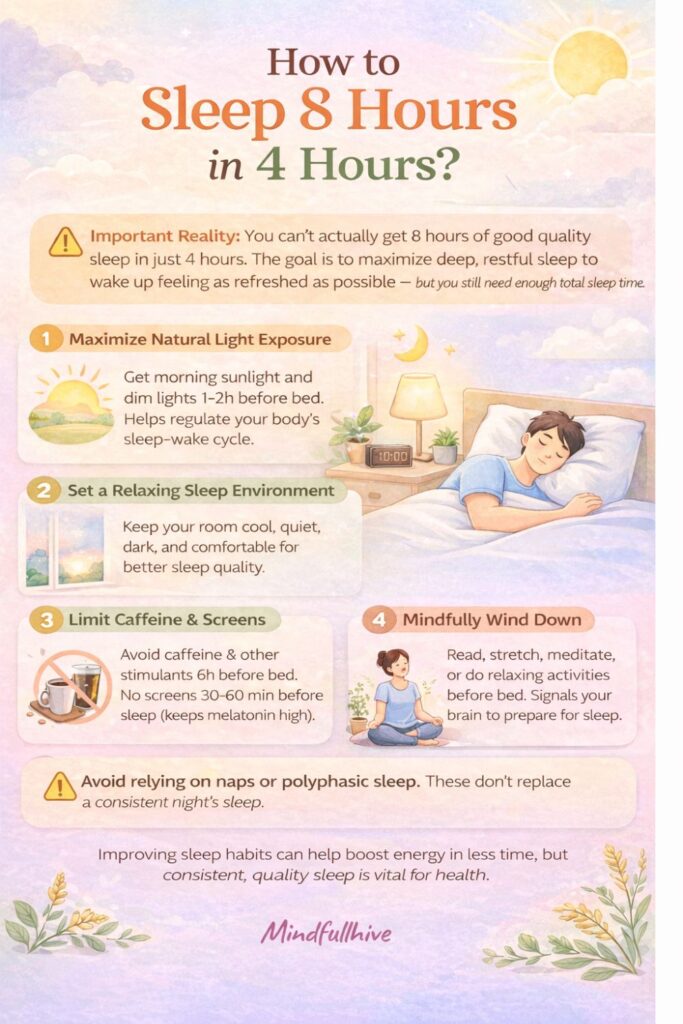
Let me be straight with you. You can't literally sleep eight hours in four, but you can make 4 hours of sleep more restorative by improving sleep quality, using naps wisely, and aligning with your body's circadian rhythm for better deep sleep and REM sleep.
I know that's not the magical answer you were hoping for. Trust me, I was disappointed too when I first learned this. But understanding why this limitation exists actually helped me find better solutions for those nights when sleep is short.
Understanding Sleep Cycles: Why Your Body Needs Time
Think of sleep like cooking rice. You can turn up the heat, but it still needs time to cook properly. Your brain goes through specific sleep cycles that can't be rushed, no matter how many tricks you try.
What Happens During a Normal Sleep Cycle
Each night, your brain cycles through different stages approximately every 90 minutes. During my research, I learned that a complete sleep cycle includes:
- Light Sleep (Stage 1 and 2): This is when you're drifting off. Your heartbeat slows down, and your body temperature drops. It's like the warm-up phase before the real work begins.
- Deep Sleep (Stage 3): This is where the magic happens. Your body repairs tissues, builds muscle, and strengthens your immune system. I noticed that when I get enough deep sleep, I wake up feeling actually refreshed, not just awake.
- REM Sleep: This stage is crucial for memory consolidation and emotional processing. Your brain is almost as active as when you're awake. Missing out on REM sleep made me foggy and irritable the next day.
Here's the problem with trying to squeeze eight hours into four. Your body needs to go through these cycles multiple times. In eight hours, you might complete 4-5 full cycles. In four hours? You're lucky to get 2-3, and they're often interrupted or incomplete.
The Role of Circadian Rhythm
Your circadian rhythm is like an internal clock that tells your body when to sleep and wake up. It's influenced by light, temperature, and your daily routine. I learned this the hard way when I tried to sleep at random times and felt terrible despite getting enough hours.
Your body produces melatonin when it gets dark, signaling that it's time to sleep. Cortisol levels rise in the morning to wake you up. Trying to override this system consistently is like swimming against a strong current. You might make some progress, but it's exhausting.
Why Most People Can't Function on 4 Hours of Sleep
I met someone at a workshop who claimed she only needed four hours of sleep per night. Turns out, she was relying heavily on coffee and had been feeling exhausted for months. She just didn't connect the dots.
The Myth of Genetic Short Sleepers
There's a rare genetic mutation (affecting less than 1% of the population) that allows some people to function perfectly on 4-6 hours of sleep. These true short sleepers are incredibly rare. The rest of us? We're just running on fumes and calling it productivity.
Research shows most adults need 7-9 hours of sleep for optimal health. When I tried to function on 4 hours of sleep regularly, I noticed:
- My concentration was awful by afternoon
- I made more mistakes at work
- I craved sugary foods constantly
- My mood was unpredictable
- Simple tasks felt overwhelming
Sleep Deprivation Risks You Can't Ignore
Chronic sleep deprivation risks go beyond feeling tired. During a particularly busy month when I averaged 4-5 hours nightly, I caught every cold going around. My immune system had given up.
Long-term effects include increased risk of heart disease, diabetes, obesity, and mental health issues. Your body needs adequate sleep quality and quantity to function properly. There's no shortcut around biology.
How to Improve Sleep Quality When Time Is Limited
Since we've established you can't actually compress eight hours into four, let's focus on making whatever sleep you get as restorative as possible. These sleep hygiene habits transformed my short sleep nights from zombie-mode to manageable.
Create the Perfect Sleep Environment
Your bedroom should be a sleep sanctuary, not a multipurpose room. I made some simple changes that dramatically improved my sleep quality:
- Temperature: Keep your room cool, around 65-68°F (18-20°C). I used to sleep in a warm room and wondered why I'd wake up multiple times. A cooler room helps your body maintain the right temperature for deep sleep.
- Darkness: I invested in blackout curtains. Even small amounts of light can disrupt your circadian rhythm. If you can see your hand in front of your face, it's too bright.
- Noise Control: White noise or earplugs made a huge difference. Living in a noisy area, I couldn't control external sounds, but I could mask them.
- Comfortable Bedding: Your mattress and pillows matter more than you think. I spent years on an old mattress, wondering why my back hurt every morning.
Develop a Consistent Sleep Routine
This was the game-changer for me. Even when I could only sleep four hours, keeping the same schedule helped my body prepare for rest.
- Fixed Sleep Schedule: Try to sleep and wake at the same times, even on weekends. Your body loves predictability. When I started sleeping at 11 PM consistently, I fell asleep faster than when my bedtime varied wildly.
- Pre-Sleep Ritual: I created a simple routine that signals my brain it's time to wind down. About an hour before bed, I dim the lights, avoid screens, and do some light stretching. My family thought it was unnecessary at first, but they noticed I was less grumpy in the mornings.
- Screen Time Management: The blue light from phones and laptops suppresses melatonin production. I used to scroll through social media until I felt sleepy. Bad idea. Now I stop screen time 60-90 minutes before bed, and falling asleep is much easier.
Diet and Lifestyle Adjustments
What you eat and when you eat it affects your sleep quality more than you'd think. Being vegetarian, I had to be mindful of getting enough nutrients that support good sleep.
- Timing Matters: I avoid heavy meals within 3 hours of bedtime. That late dinner with family? It made me lie awake with indigestion. Now I keep dinner light and early.
- Caffeine Cutoff: I love chai, but I learned to stop drinking it after 2 PM. Caffeine stays in your system for 6-8 hours. Even if you fall asleep, it reduces deep sleep and REM sleep quality.
- Sleep-Supporting Foods: Foods rich in magnesium (almonds, spinach, bananas) and tryptophan (milk, pumpkin seeds, tofu) can help. My go-to before bed is warm milk with a pinch of turmeric, something passed down in our family.
- Hydration Balance: Drink enough water during the day, but taper off in the evening. Waking up multiple times to use the bathroom interrupts your sleep cycles.
Exploring Polyphasic Sleep Schedules
When I first heard about polyphasic sleep, it sounded like the perfect solution. Multiple short sleep periods throughout the day instead of one long stretch? Sign me up! But reality was more complicated.
What Is Polyphasic Sleep?
- Polyphasic sleep schedules involve breaking your sleep into multiple segments instead of one long period. The most common types are:
- Biphasic Sleep: This involves a longer sleep period (5-6 hours) at night plus a short nap (20-30 minutes) during the day. This is actually practiced in many cultures with siesta traditions.
- Everyman Schedule: You sleep for 3-4 hours at night and take three 20-minute naps throughout the day.
- Uberman Schedule: The most extreme version involves six 20-minute naps spread evenly throughout the day, with no long sleep period.
My Experience Testing Polyphasic Sleep
I tried a modified Everyman schedule for two weeks. The idea was to sleep four hours at night and take two 20-minute naps during the day. Here's what happened:
Week 1: Absolute disaster. I was exhausted, irritable, and couldn't focus on anything. My body was in shock from the sudden change. I fell asleep during one of my work calls (thankfully, my camera was off).
Week 2: Things improved slightly as my body adapted, but I still felt like I was operating at 70% capacity. The naps helped, but coordinating them with my work schedule was nearly impossible.
The Reality Check on Polyphasic Sleep
Most polyphasic sleep research shows that while some people can adapt to these schedules, they still don't get the same restorative benefits as traditional sleep. You might feel functional, but studies suggest similar sleep deprivation risks as chronic short sleep.
The biggest challenge? Modern life doesn't support these schedules. Try explaining to your boss why you need to take three 20-minute naps during work hours. Unless you have complete control over your schedule, it's impractical.
Strategic Napping: Your Best Friend for Short Sleep
If you can't get eight hours at night, strategic napping might be your best option. This is where I found real, practical help.
The Science Behind Effective Napping
Not all naps are created equal. The timing and duration make all the difference. Here's what I learned through trial and error:
- Power Naps (10-20 minutes): These short naps boost alertness without entering deep sleep. You wake up refreshed, not groggy. I take these around 2 PM when my energy naturally dips.
- Longer Naps (90 minutes): If you have time, a full sleep cycle nap can be incredibly restorative. You go through all stages, including REM sleep. But timing is crucial. I can only do these on weekends.
My Nap Schedule That Actually Works
After months of experimentation, I found a nap schedule that complements short night sleep without making things worse:
- Timing: I nap between 1-3 PM, during the natural afternoon dip in my circadian rhythm. Napping too late (after 4 PM) makes it harder to fall asleep at night.
- Duration: I stick to 20-25 minutes max for weekday naps. I set two alarms because oversleeping a nap makes me feel worse than not napping at all.
- Environment: I use the same sleep hygiene principles as nighttime. Dark room, comfortable position, no distractions.
- Consistency: I try to nap around the same time daily. My body now expects it, and I fall asleep within minutes.
One important lesson: Naps supplement sleep, they don't replace it. On days when I got only four hours at night, a 20-minute nap helped me function, but I still felt the effects of sleep debt building up over time.
What Really Works: Maximizing Sleep Quality
After trying various approaches, here's my honest assessment of what actually helps when you're stuck with limited sleep time.
Accept Your Body's Biological Needs
This was the hardest lesson. I wanted to believe I could hack my way to needing less sleep. But fighting against your body's needs is a losing battle. Most people genuinely need 7-9 hours for optimal functioning.
When I accepted this, I stopped feeling guilty about prioritizing sleep and started making real changes to my schedule. Sometimes that meant saying no to late-night plans or delegating tasks at work.
Focus on Consistency Over Perfection
I used to think that if I couldn't get a full eight hours, there was no point in trying to sleep well. Wrong. Even if you can only manage six hours on weeknights, making those six hours high-quality sleep makes a significant difference.
Keeping a consistent schedule, even on weekends, helped more than I expected. My body learned when to produce melatonin, when to wake up, and how to make the most of available sleep time.
Build Sleep Debt Repayment Into Your Schedule
When you consistently sleep less than you need, you accumulate sleep debt. I learned to plan for this. After a week of short sleep, I'd try to get 8-9 hours on the weekend to partially repay the debt.
It's not perfect. You can't completely make up for chronic short sleep with weekend catch-up. But it's better than nothing, and I noticed improved energy and mood when I did this consistently.
Listen to Your Body's Signals
Your body tells you when it's not getting enough sleep. I ignored these signals for months:
- Needing multiple alarms to wake up
- Feeling drowsy during the day despite caffeine
- Making careless mistakes
- Feeling emotionally fragile
- Getting sick frequently
When I started paying attention to these signs, I realized my "I'm fine on 5 hours" claim was complete nonsense. I was just used to feeling tired.
Practical Tips for Better Sleep Quality
Let me share the specific tactics that worked best for improving my sleep quality when time was limited:
Before Bed
- Temperature Adjustment: I take a warm shower 60-90 minutes before bed. As my body temperature drops afterward, it triggers sleepiness. This simple trick helped me fall asleep 10-15 minutes faster.
- Mental Download: I keep a notebook by my bed to jot down tomorrow's tasks or random thoughts. This prevents my mind from racing when I should be sleeping.
- Relaxation Techniques: Simple breathing exercises calm my nervous system. I breathe in for 4 counts, hold for 7, exhale for 8. After a few rounds, I'm noticeably more relaxed.
During Sleep
- Minimize Disruptions: I put my phone on airplane mode. No notifications, no temptation to check messages. If someone really needs me, they can call the landline.
- Optimize Sleep Position: I sleep on my side with a pillow between my knees. It took time to find the right position, but it reduced the number of times I woke up from discomfort.
After Waking
- Light Exposure: I open my curtains immediately upon waking. Natural light signals to my circadian rhythm that it's time to be alert. This helped me feel more awake faster than any amount of coffee.
- Consistent Wake Time: Even on days when I could sleep in, I wake up within an hour of my usual time. This keeps my sleep schedule stable.
The Bottom Line: Quality Over Quick Fixes
Here's what I wish someone had told me from the start: there's no magic trick to compress eight hours of sleep quality into four hours of actual sleep. Your brain and body need time to complete essential processes that can't be rushed.
But you're not powerless. By improving sleep hygiene, understanding your sleep cycles, and working with your circadian rhythm instead of against it, you can make limited sleep more restorative.
If you're consistently getting only 4 hours of sleep, please know that's not sustainable long-term. I tried it, and the sleep deprivation risks caught up with me. Exhaustion, reduced immunity, weight gain, mood problems... they're all real.
My best advice? Prioritize sleep like you prioritize eating or breathing. It's not lazy or unproductive. Quality sleep makes you more effective in everything else you do. When I finally accepted this and started protecting my sleep time, I was actually more productive during my waking hours.
Start small. Pick one or two sleep hygiene habits to implement this week. Maybe it's setting a consistent bedtime or removing your phone from the bedroom. Build from there.
Your body has been taking care of you your whole life. Give it the rest it needs to keep doing that job well.
Frequently Asked Questions
Can anyone really function on 4 hours of sleep?
Very few people have a rare genetic mutation that allows them to function well on 4-6 hours of sleep. For the vast majority of us (99% of the population), consistently getting only 4 hours leads to accumulating sleep debt, reduced cognitive function, and health risks. If you think you're in that 1%, you should get genetic testing to confirm rather than assuming.
Is polyphasic sleep healthy?
Research on polyphasic sleep is limited, but existing studies suggest it carries similar risks to regular sleep deprivation for most people. While some individuals adapt to these schedules, they often don't achieve the same sleep quality as traditional monophasic sleep. The lifestyle constraints also make it impractical for most people. If you're considering it, start conservatively and monitor how you actually feel, not just how you think you should feel.
What's the best nap schedule?
Short 20-30 minute naps during your natural midday energy dip (usually between 1-3 PM) can boost alertness without interfering with nighttime sleep. These power naps prevent you from entering deep sleep, so you wake up refreshed rather than groggy. If you can manage a full 90-minute nap occasionally, that allows you to complete an entire sleep cycle, which is more restorative but requires more time and careful scheduling.
Does sleep quality matter more than duration?
Both sleep quality and quantity matter, and they work together. You need enough time to complete multiple sleep cycles (quantity), but you also need those cycles to be uninterrupted and restorative (quality). High-quality 6-hour sleep is better than restless 8-hour sleep, but high-quality 8-hour sleep is better than high-quality 6-hour sleep. Don't sacrifice one for the other when possible.
Can changing lifestyle help me need less sleep?
Improving your sleep hygiene and lifestyle habits will help you feel more rested and make better use of the sleep you get, but they won't significantly reduce your biological sleep needs. Good sleep habits can help you function better on temporarily shortened sleep, but they can't eliminate your body's requirement for 7-9 hours long-term. Think of it like eating healthy, you'll feel better, but you still need to eat.
Quick Tips
Avoid screens 60-90 minutes before sleep. The blue light from phones, tablets, and computers suppresses melatonin production, making it harder to fall asleep and reducing sleep quality. If you must use devices, enable blue light filters or wear blue-light-blocking glasses.
Keep your room dark and cool. Aim for 65-68°F (18-20°C) and use blackout curtains or an eye mask. A cool, dark environment supports your body's natural temperature drop during sleep and protects your circadian rhythm from light disruption.