
Last winter, I ordered a pair of high-waisted jeans online, and they arrived nearly five centimetres too long. My tailor was buried in wedding orders, and I had a family dinner in two days. So I sat on my bedroom floor with a needle, a spool of thread and a lot of doubt. That evening, I learned how to hem jeans by hand, and it was far easier than I expected.
Jeans that are too long drag on the ground, soak up rain and wear out at the edges. If you have ever typed jeans ki lambai kaise kam kare into a search bar at midnight, this guide is for you. I will share what worked, what failed and what I would change next time. You only need basic tools, one quiet evening and no sewing machine. Here at Mindful Hive, I share simple projects like this one.
Quick Answer: How to Hem Jeans by Hand
To hem jeans by hand, try them on with your usual shoes and mark the desired length. Turn the jeans inside out, fold the raw edge twice, pin it evenly, then sew the fold with small slip stitches using strong thread. Press the hem flat.
To hem jeans by hand, first wear them with the shoes you normally use and mark the final length on both legs. For a standard hem, leave enough extra denim to fold the raw edge inward twice, press the fold, and pin it evenly. Use a strong needle and matching polyester thread, then sew with small slip stitches or a blind hem stitch. If you want to avoid cutting, fold the extra length inside and stitch it temporarily. To keep the factory finish, use an original-hem method, but expect a bulkier inner fold.
What You Will Need to Hem Jeans at Home
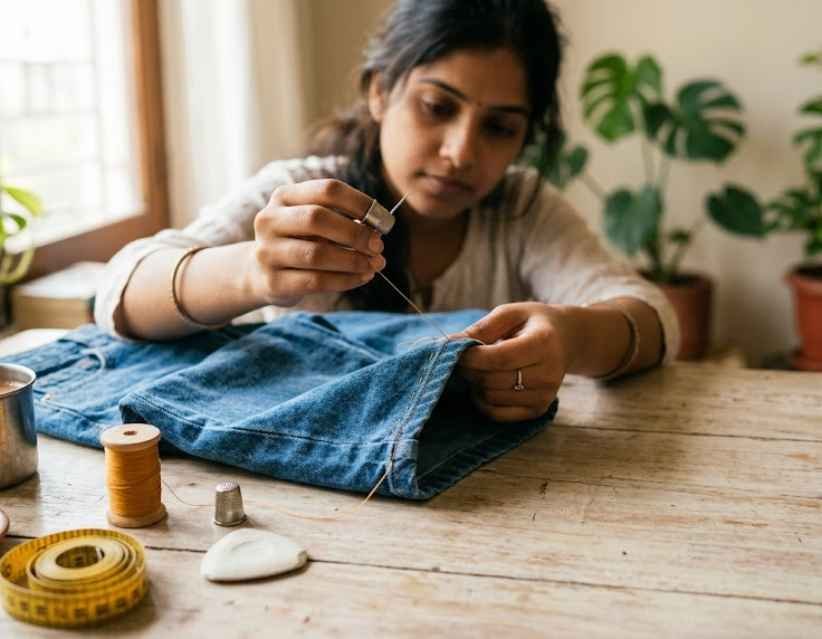
Most of this was already in my mother’s sewing box. Here is the honest list for anyone learning how to hem jeans by hand for the first time.
Essential Tools
- Heavy-duty thread in a shade close to your denim
- A sharp sewing needle that can pass through thick layers
- A measuring tape with centimetres and inches
- Fabric chalk or a washable marker
- Sewing pins or small clips
- Sharp scissors
- An iron and ironing board
Optional Extras
A thimble saves your finger from sore dents. Keep a seam ripper handy for opening an old hem. A plain hammer, used gently, flattens bulky seams, and I will explain that trick below.
How to Measure the Correct Jeans Length
Before you learn how to hem jeans by hand, you need an accurate length, and measuring is where most beginners slip. I was no exception. My first leg ended up a full centimetre shorter than the second because I measured on different days in different shoes.
Habit two in The 7 Habits of Highly Effective People says to begin with the end in mind, and that applies here too.
Wear the Right Shoes
Put on the exact footwear you plan to wear with these jeans. Sneakers need a different length than block heels. Stand straight on a flat floor, not on a carpet.
Mark Both Legs Evenly
Fold the hem up from the bottom until the length looks right, then pin it. Check in a mirror. Repeat on the other leg and compare both with a measuring tape, starting from the crotch seam. Finish by marking the fold with fabric chalk. A hem about 1 cm (0.4 inch) above the floor at the back looks tidy on straight-leg jeans.
How to Hem Jeans by Hand Step by Step
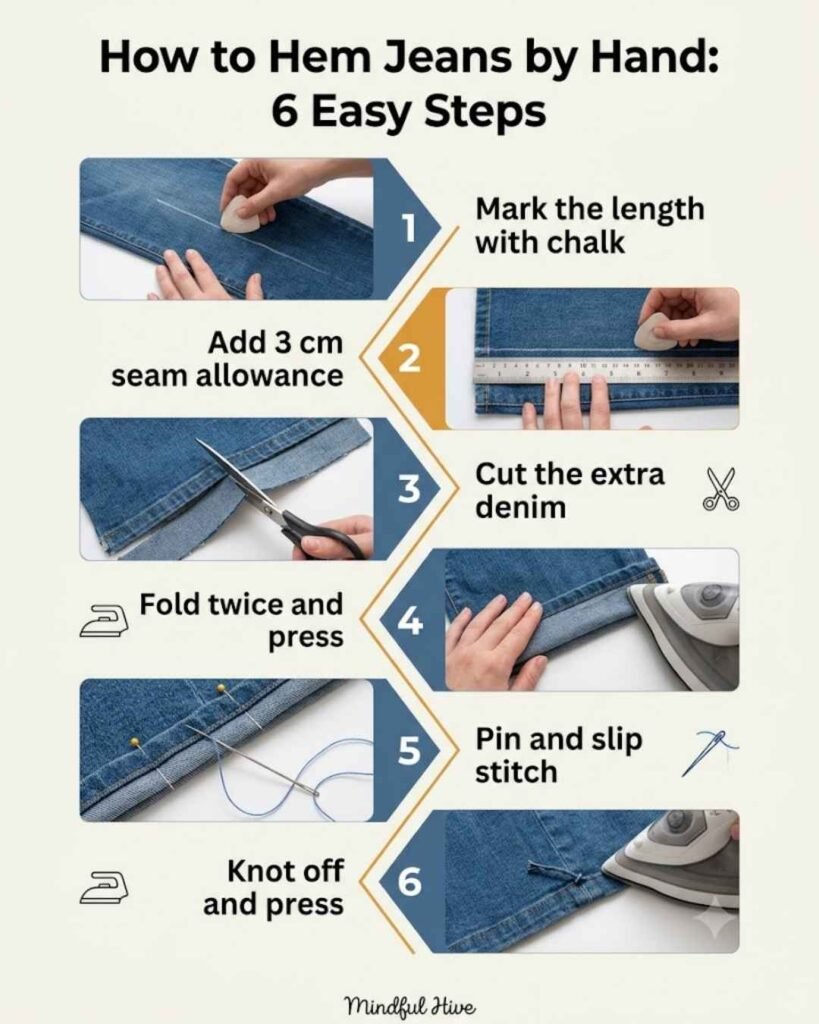
Here is how to hem jeans by hand using the standard method. It creates a new, neat hemline and suits straight, bootcut and wide-leg jeans. Set aside about 90 minutes for your first pair.
Step 1: Mark the Final Length and Seam Allowance
Start with the hemline you marked earlier. Then measure 3 cm (1.2 inches) below it and draw a second line. That extra strip is your denim seam allowance, and it gives you enough fabric for a double-fold hem. Do not cut anything yet.
Step 2: Cut the Extra Denim, but Only When You Are Sure
Lay the jeans flat and cut along the lower line. Use the first leg as a template for the second so both match. Cutting is permanent, so check both lengths one last time. If you feel even slightly unsure, jump to the no-cut method below.
Step 3: Fold Twice and Press
Turn the jeans inside out. Fold the raw edge up by 1 cm (0.4 inch), then fold again by 2 cm (0.8 inch). The double fold traps the raw edge, which stops fraying. Press with a hot iron, and use a damp cloth if the denim is stubborn. I used to skip pressing, and my first hem showed it.
Step 4: Pin or Clip the Fold
Place pins or clips every 3 to 4 cm, pushing them in straight across the fold. Clips are kinder to thick denim. Check the side seams, because bulk piles up there.
Step 5: Thread the Needle and Start Stitching
Cut about 60 cm of thread, double it and knot the end. Start inside the fold so the knot stays hidden. Bring the needle up through the folded edge, pick up two or three threads of the outer denim, and pull through. Continue around the leg with small slip stitches, spaced about 3 to 4 mm apart.
Keep Your Tension Relaxed
Pull the thread until it lies flat, not tight. Tight stitches pucker the denim and show on the front.
Step 6: Secure the Thread and Press Again
At the starting point, make three tiny stitches in the same spot and knot off inside the fold. Press the hem once more, then try the jeans on and enjoy the moment.
What My First Attempt Taught Me
My first leg took nearly an hour because I second-guessed every stitch. The second leg took twenty minutes. By the end, my stitches were even, and I had stopped checking them every few seconds.
How to Hem Jeans Without Cutting Them
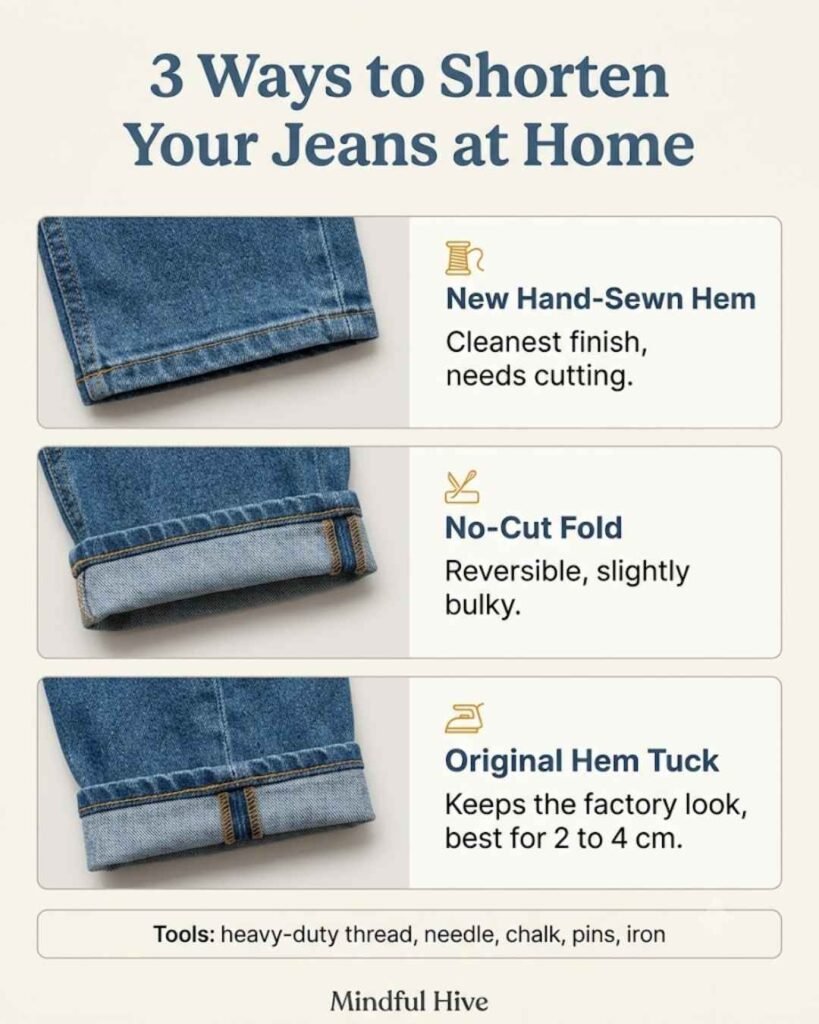
This is my favourite method when I am unsure about the length. It also suits jeans for growing kids, since nothing gets cut and you can undo it later.
How to Shorten Jeans Without Cutting: Fold and Stitch
Fold the extra length to the inside of each leg and press it flat. Sew the fold to the existing hem with loose blind stitches, catching only a thread or two on the outside. Keep stitches about 1 cm apart.
When the No-Cut Method Works Best
It suits temporary changes, or a pair you might wear with heels later. The inner fold feels bulky, and thick jeans can look slightly puffy at the ankle. For a long-term fix, a proper new hem looks cleaner. If you have ever searched jeans ko chhota kaise kare and feared a wrong cut, this reversible route is the safest start.
How to Keep the Original Hem When Shortening Jeans
The worn, slightly uneven original factory hem is what many of us love about a good pair of jeans. Cutting it off can make them look homemade.
How the Original Hem Technique Works
Turn the jeans inside out and measure up from the top edge of the old hem by the amount you want to remove. Fold the excess fabric into a flat tuck just above that hem, pin it, and stitch the tuck down by hand. Catch only the inner layer so no thread shows outside.
When It Is Worth Choosing
Pick this for slim fits and faded washes where the hem has character. It works best for shortening 2 to 4 cm (about 1 to 1.5 inches). Bigger changes make the inner tuck too bulky, and a tailor may do a better job.
Which Stitch and Thread Work Best for Denim?
Slip Stitch vs Blind Hem Stitch
The slip stitch for denim is my first choice. Slide the needle through the fold for about 6 mm, then pick up one or two threads of the leg fabric, and repeat. A blind hem stitch is similar but angles slightly between layers, which grips heavy fabric well. Both stay nearly invisible from the front.
Choosing Thread
Go for polyester heavy-duty thread or dedicated denim thread. Ordinary cotton thread frays on thick seams and snaps easily. Match the colour to your jeans for a hidden finish, or pick the golden-orange topstitch shade if you like a visible detail.
Tips for Sewing Thick Denim and Side Seams
Handling Bulky Side Seams
The thick side seams are the toughest part, since several layers of denim meet there. Tap them flat with a hammer, gently, or press them first. Push the needle with the side of a thimble and go slowly. If it refuses to move, take a few extra stitches around the seam instead of through it.
Protect Your Fingers and Your Eyes
Hand sewing is slow work, so sew in daylight and rest between legs. Tired eyes make crooked stitches, so if busy weeks cut into your rest, read how to sleep 8hrs in 4hrs. Keep a snack nearby, like strawberries or toast with peanut butter, and pour a cup of chai.
Common Hemming Mistakes and How to Fix Them
Even people who know how to hem jeans by hand slip up sometimes. Here are the usual culprits.
Uneven Hems
This happens when the legs are measured separately. Unpick the stitches, re-measure both legs from the crotch seam and fold again.
Puckering and Visible Stitches
Loosen your tension and take smaller bites of the outer fabric. Press the hem again to settle the stitches.
Thread Breakage and Fraying
Switch to heavy-duty thread and double it. If the raw edge keeps fraying, fold it twice or run a few overcast stitches along it first.
Cutting Too Much Fabric
Always leave a 3 cm allowance. If you cut slightly short, use a single narrow fold with hem tape instead of a double fold.
How to Wash and Care for Hand-Hemmed Jeans
Turn the jeans inside out and wash in cold water. Check the care label first, since high heat can shrink denim and pull the hem out of shape. Hang them to dry.
Frequently Asked Questions: How to Hem Jeans by Hand
Can I hem jeans by hand without a sewing machine?
Yes. Use a sturdy needle, strong thread and small, even stitches to secure the folded denim.
What stitch is best for hemming jeans by hand?
A slip stitch or blind hem stitch works well when you want the stitching to remain discreet on the outside.
How can I shorten jeans without cutting them?
Fold the extra length inside the legs, press the fold and hand-sew it in place. Expect some extra bulk.
How do I sew through thick denim?
Use a suitable sharp needle, strong thread and a thimble. Work slowly through bulky side seams.
Can I keep the original hem on my jeans?
Yes. An original-hem alteration can preserve the factory-finished edge, though it takes more careful measuring.
Two Quick Tips for Better Results
Quick Tip 1: Check Before Cutting
Try on the pinned jeans with your usual shoes and confirm both legs are even before cutting any fabric.
Quick Tip 2: Press the Finished Hem
Press the completed hem according to the denim’s care label so the fold sits neatly.
Final Thoughts on How to Hem Jeans by Hand
That too-long pair now sits in my regular rotation, and nobody has noticed the hem. Learning how to hem jeans by hand saved me a tailor bill and gave me a small win I was proud of. Start with the no-cut method if you feel nervous, then move on to a full new hem. On busy sewing weekends, a 7-day healthy eating plan keeps dinner simple.