


Last winter, I sat cross-legged on my bed with my laptop, three bank statements, and a half-finished cup of chai, trying to answer a question a colleague kept asking me over lunch: "So what's your net worth?" I laughed it off the first time because I genuinely had no clue. I was earning a decent salary, saving a little every month, and I thought that meant I was doing fine financially. It was only when I actually sat down to learn how to calculate net worth that I realised salary and net worth are two completely different things. If you've typed "how to calculate net worth" into Google because you're just as confused as I was, this guide will walk you through the exact formula, a real rupee example, and every asset and liability an Indian reader needs to count.
What Is Net Worth and Why It Matters More Than Your Salary
Net worth is simply the difference between what you own and what you owe. It's a single number that tells you where you actually stand financially, not how much you earn every month.
This distinction matters a lot. Someone earning one lakh rupees a month with heavy credit card debt and no savings can have a lower net worth than someone earning half of that who has been quietly building an emergency fund and investing every month. Your salary is what comes in. Your net worth is what stays.
A positive net worth means your assets are worth more than your debts. A negative net worth means the opposite, and it's far more common among young earners than people admit, especially in the first few years of a career when education loans and credit cards are still active.
How to Calculate Net Worth: The Simple Formula

Here's the part that made everything click for me. Net worth isn't complicated maths. It's one straightforward formula:
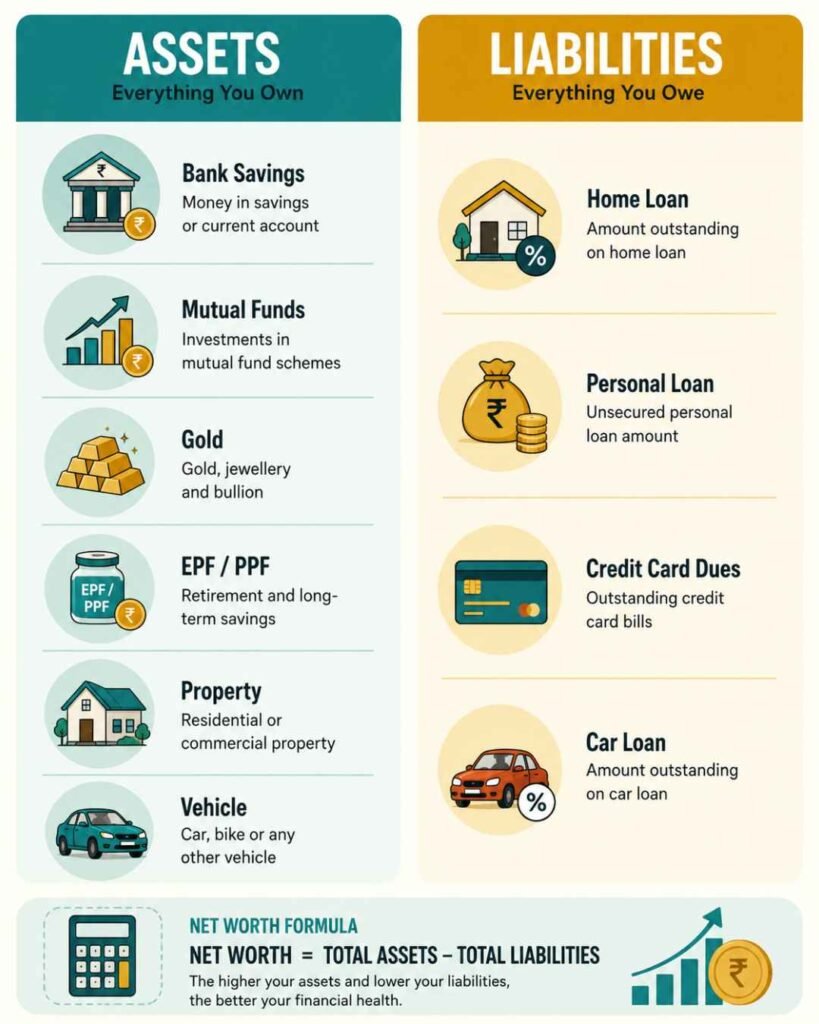
Net Worth = Total Assets − Total Liabilities
To understand how to calculate net worth properly, you only need to do three things:
- Add up the current value of everything you own (your assets).
- Add up everything you currently owe (your liabilities).
- Subtract the second number from the first.
That's it. There's no complex ratio, no advanced spreadsheet formula, and no accounting degree required. The only skill involved is being honest and thorough about what actually belongs in each list, which is exactly what the next two sections cover.
Step 1: List Every Asset You Own
The first time I did this exercise, I only thought of my bank balance. I forgot my provident fund, my small mutual fund SIP, and even the gold coins my mother had gifted me on my birthday. Assets go far beyond cash, so go slowly through each category below.
Cash and Bank Accounts
This includes your savings account balance, current account balance, and any physical cash you're holding.
Investments
Add the current market value of your mutual funds, stocks, bonds, and ETFs. Use today's value, not what you originally invested.
Retirement Savings
Your EPF, PPF, and NPS balances count as assets too, even though you can't touch this money right now. Check your latest passbook or the EPFO portal for the exact figure.
Fixed Deposits and Recurring Deposits
Add up your fixed deposits and RDs at their current maturity value, not the amount you originally deposited.
Gold and Jewellery
Use the current market value of your gold, not the price you or your family paid for it years ago. Gold rates change constantly, so check today's rate before adding this number.
Property and Land
If you own a flat, house, or land, use a realistic current market estimate rather than the original purchase price.
Vehicles
Use the honest resale value of your car or bike, not the showroom price you paid when it was new.
Other Assets
This can include a share in a family business, valuable equipment, or any other asset with real resale value.
Step 2: List Every Liability You Owe
This step is uncomfortable, but skipping it defeats the entire purpose of learning how to calculate net worth. Be brutally honest here.
Home Loan, Car Loan, and Personal Loan
Use the current outstanding debt amount left on the loan, not the original loan amount you borrowed.
Credit Card Dues and BNPL
Add your current credit card debt and any Buy Now Pay Later dues that haven't been cleared yet.
Education Loan, Gold Loan, and Informal Debt
Don't forget an education loan, a gold loan, or even money borrowed informally from family or friends. If you owe it, it counts.
Step 3: Subtract Liabilities From Assets (My Actual Example)
Here's a simplified version of what my own worksheet looked like when I finally sat down and worked through it.
My assets added up like this: bank savings of two lakh rupees, a fixed deposit worth one and a half lakh rupees, mutual funds worth three lakh rupees, EPF balance of one lakh rupees, gold worth two lakh rupees, and a scooter worth fifty thousand rupees. That brought my total assets to ten lakh rupees.
My liabilities looked like this: a personal loan balance of one lakh fifty thousand rupees and credit card dues of thirty thousand rupees, bringing my total liabilities to one lakh eighty thousand rupees.
Net Worth = ₹10,00,000 − ₹1,80,000 = ₹8,20,000
Seeing that number in writing changed how I looked at my own spending. It wasn't about feeling proud or embarrassed. It was simply useful information I didn't have before.
What Counts as Assets and Liabilities When You Calculate Net Worth
A quick recap, since this is where most people get stuck. Assets include cash, bank balance, investments, retirement savings, fixed deposits, gold, property, and vehicles. Liabilities include home loans, personal loans, car loans, education loans, gold loans, credit card dues, and money owed to anyone else. Anything you genuinely own goes on one side, and anything you genuinely owe goes on the other. Future salary, expected bonuses, and possible inheritance should never be included, since these aren't real assets yet.
Net Worth vs Liquid Net Worth: The Real Difference
This is something most articles skip, and it's important. Your total net worth includes everything, even property and gold that would take time to sell. Your liquid net worth only counts assets you could realistically convert to cash quickly, like your bank balance, FDs, and mutual funds.
I learned this the hard way when I realised my net worth looked healthy on paper mostly because of gold I wasn't planning to sell anytime soon. Liquid net worth gave me a far more honest picture of how much money I could actually access in an emergency.
How Often Should You Calculate Your Net Worth
Once every three to six months is enough, or at minimum, once a year. Checking it daily is pointless and slightly stressful, since market values and gold rates fluctuate constantly. I personally do mine every quarter, usually on a slow Sunday evening.
Common Mistakes People Make While Calculating Net Worth
A few mistakes come up again and again, and I made most of them myself the first time around.
- Using the original purchase price of property or gold instead of the current value
- Forgetting EPF and PPF balances entirely
- Ignoring small credit card dues because they feel insignificant
- Counting future salary or an expected bonus as an asset
- Counting expected inheritance before it's actually received
- Using the original loan amount instead of the remaining outstanding balance
- Overvaluing an old vehicle out of sentiment rather than realistic resale value
How to Increase Your Net Worth Over Time
Improving this number isn't about a single big move. It's built from small, repeated habits, which is honestly the same lesson I picked up from The 7 Habits of Highly Effective People, where consistency beats intensity every single time.
A few things that genuinely helped me:
- Automating a fixed amount into a SIP every month instead of saving "whatever is left"
- Paying off high-interest personal loans and credit card dues before anything else
- Building a small emergency fund so an unexpected expense, like a sudden cough syrup and doctor visit during flu season, doesn't push me back into debt
- Reviewing my investments instead of letting them sit untouched for years
- Cutting a few unnecessary subscriptions and redirecting that money into savings
Even lifestyle choices add up here. I follow a mostly 7-day healthy eating plan at home, which keeps my grocery bill predictable and my meals vegetarian without ordering food out of habit. Small swaps matter too. I switched from expensive snacks to simply peanut butter on toast, which is filling, budget-friendly, and doesn't need eggs, since my whole family is vegetarian. And when I do want a small treat, something as simple as strawberries feels indulgent without denting my monthly budget the way eating out does.
Sleep and energy matter for money decisions too, more than people realise. Tired, rushed decisions tend to be expensive decisions. I picked up a few tricks from an article on how to sleep 8 hours in 4 hours on those weeks when work gets hectic, since being well rested makes me far less likely to impulse spend. And on the rare weekend I want to pamper myself without spending much, something like batana oil for my hair costs a fraction of a salon visit and still feels like self-care.
None of this is about restriction. It's about being intentional, the same way you'd be intentional the moment you decide to actually learn how to calculate net worth instead of guessing.
FAQs About How to Calculate Net Worth
What is the formula for calculating net worth?
Net Worth = Total Assets − Total Liabilities. Add the current value of everything you own, then subtract everything you owe.
How do I calculate my net worth in India specifically?
List your savings, investments, EPF, PPF, NPS, gold, and property as assets. Then subtract home loans, personal loans, credit card dues, and any other outstanding debt.
Is a car considered an asset when calculating net worth?
Yes, but use its realistic current resale value rather than the price you originally paid for it.
Should I include my EPF and PPF balance in my net worth?
Yes. These are financial assets, even though you can't withdraw them immediately.
Is having a negative net worth a bad sign?
Not permanently. It simply means your liabilities currently exceed your assets. Paying down high-interest debt and saving consistently can turn this around over time.
Quick Tip 1: Update your numbers every three to six months instead of checking your net worth every single day.
Quick Tip 2: Always use current market values, especially for gold, property, and vehicles, rather than what you originally paid.
Final Thoughts
I started this exercise expecting to feel embarrassed about my finances. Instead, I felt oddly in control for the first time. Knowing how to calculate net worth didn't require a finance degree or a fancy app. It just required an honest hour with my bank statements and a calculator.
If you've been putting this off, block out thirty minutes this weekend. List your assets, list your liabilities, subtract one from the other, and see where you actually stand. You might be pleasantly surprised, or you might find a clear starting point to improve from. Either way, you'll know, and that's worth more than guessing.
For more everyday money and lifestyle guides, head over to Mindful Hive.